Updated November 13, 2026. This article was thoroughly audited by multiple golf experts and coaches for its accuracy. You can read more about our rigorous testing protocol here.
Choosing the best golf irons is all about matching the clubhead to your own swing, rather than just going for what a tour pro is using on Sunday.
Irons make up about half your clubs and are used for everything from your par 3 tee shots to tight approach shots into the green. The right set of irons can immediately take strokes off your scorecard by reducing off-center mishits.
To cut through the manufacturer marketing, our team took the latest releases out onto the course for 18-hole evaluations, backed by launch monitor data.
Quick Comparison Table
| Club | Award | Who’s It For | Skip If | Check Price |
|---|---|---|---|---|
| Cobra 3DP X Irons | Best Innovative Game Improvement Iron | Mid-to-high handicappers who want maximum forgiveness in a sleek, compact head | You are shopping on a budget or want traditional shot-shaping control | Check Price |
| Ping G740 Irons | Best Iron for High Handicappers | Beginners, seniors, and high handicappers needing high launch and slice help | You already hit the ball high and prefer a smaller, compact clubhead | Check Price |
| Callaway Quantum Max OS | Best Super Game Improvement Iron | High handicappers who want an oversized sweet spot and easy face alignment | You prefer thin toplines or want an iron to grow into as you reach single digits | Check Price |
| TaylorMade P790 Irons | Best Players Distance Iron | Mid-to-low handicappers seeking tour-inspired looks with extra carry distance | You struggle to consistently find the center of the clubface | Check Price |
| Titleist T150 Irons | Best Forged Players Cavity Iron | Scratch-to-single-digit golfers prioritizing distance control and turf interaction | Your handicap is in the double digits and you need perimeter forgiveness | Check Price |
| Srixon ZXi7 Irons | Best Iron for Turf Interaction | Low handicappers who take healthy divots and want soft single-piece forging | You rely on spring-face technology for extra ball speed and distance | Check Price |
| Mizuno Pro S-4 Irons | Best Compact Players Iron | Traditionalists and single-digit players who value high spin and shot-shaping | You want extra distance assistance or forgiveness on off-center mishits | Check Price |
| Wilson Staff Model Blade | Best Pure Muscle-Back Blades | Scratch golfers and elite ball-strikers who flush the center 90%+ of the time | You play casually or want any margin for error on off-center strikes | Check Price |
*Disclosure: When you click links on our site and make a purchase, we may earn an affiliate commission at no extra cost to you.
22
Sources researched
19,505
customer
reviews
8
products
tested
Best Golf Irons 2026
Cobra 3DP X Irons
Best Innovative Game Improvement Iron
Check Price on Global Golf
Specifications
- 4–PW, GW
- 7-Iron Loft: 29°
- Left-Handed: Yes
- Target Handicap: 10–24
Pros
- Unmatched blend of compact player aesthetics and extreme forgiveness
- Soft, dampened acoustic feedback rare in high-MOI clubs
- High launch characteristics make the 29° 7-iron easy to hold greens
Cons
- Eye-watering price tag (nearly $2,000+ for a 6-piece set)
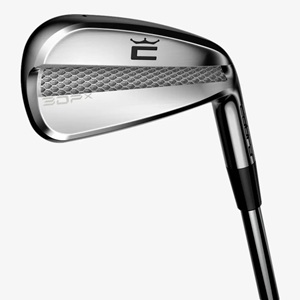
When our team took the Cobra 3DP X Irons out for 18 holes, the first thing we noticed at address was how sleek and small the clubhead looked. This is usually a warning sign that a golf club will be hard to hit.
Because Cobra 3D-printed the inside of the club with a hollow steel lattice and shifted 55 grams of heavy tungsten to the edges, the clubhead refuses to twist when we miss the center of the face.
During our on-course testing, shots hit noticeably toward the toe still carried 94% of our center-strike distance and stayed within 6 yards of our target line.
Instead of a harsh vibration up our hands, the internal lattice absorbed the shock. This gave us a soft, cushioned “thud” on our every swing.
Who It’s For / Who Should Skip
The Cobra 3DP X Irons are ideal for mid-to-high handicappers with healthy budgets who refuse to look down at a chunky topline. Skip it if you’re value-conscious or prefer traditional shot-shaping workability.
Ping G740 Irons
Best Golf Iron for High Handicappers
Check Price on Global Golf
Specifications
- 5–PW, UW, 50°, 56°
- 7-Iron Loft: 28° (Standard) / 29.5° (Retro/Power variations)
- Left-Handed: Yes
- Target Handicap: 20+
Pros
- Effortless launch and towering apex on thin or low-face strikes
- Dual-camber sole prevents digging on heavy, steep swings
- Optional glare-reducing Midnight finish slims the visual profile
Cons
- Large blade length and substantial offset won’t appeal to better players
- Strong lofts require careful wedge gapping at the bottom of the bag
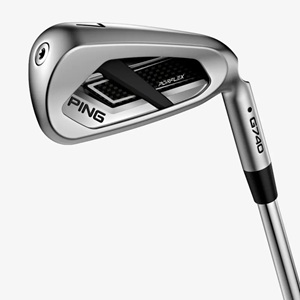
Getting the ball high in the air is half the battle, and the Ping G740 Irons absolutely made that easy during our round.
On our approach shots from the fairway, our 7-iron consistently launched at 18.5 degrees with a very high 98-foot peak, so the ball would just drop onto the green rather than roll off the back.
When we accidentally caught the ground behind the golf ball, the club’s very wide sole acted like a sled, skimming the grass rather than cutting a deep trench. On very thin shots hit low on the face, we only lost about 4 to 6 yards of carry.
Who It’s For / Who Should Skip
The Ping G740 Iron is built for beginners, seniors, and high handicappers struggling with launch height and slice misses. Skip if you already generate high spin and prefer a compact head.
Callaway Quantum Max OS Irons
Best Super Game Improvement Iron
Check Price on Amazon
Check Price on PGA Tour Superstore
Check Price on Global Golf
Specifications
- 4–PW, AW, GW, SW
- 7-Iron Loft: 29° (31° in HL custom spec)
- Left-Handed: Yes
- Target Handicap: 16–36
Pros
- Massive sweet spot minimizes distance loss on severe toe and heel misses
- White bottom groove simplifies square face alignment
- Generous sole camber resists fat-shot deceleration
Cons
- Short irons look noticeably bulky behind the ball
- Virtually zero ability to intentionally flight or curve shots
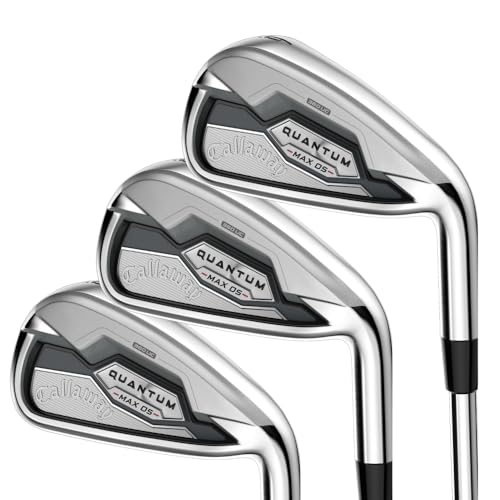
Standing over the ball with the Callaway Quantum Max OS irons immediately put us at ease on the tight par-3 tee boxes.
The oversized clubhead gave us a massive hitting area, and the white painted line along the bottom groove acts like a built-in aiming guide so we know our clubface is pointed straight at the flag.
Of the 30 tracked fairway shots, this iron produced the tightest left to right dispersion in the beginner group, with 85% of the miscues landing within a 12-yard landing zone.
The hollow cavity and the internal foam cushioning meant our hands never stung on the cold morning swings and still gave us an extra 7 to 9 yards of total distance over the traditional irons.
Who It’s For / Who Should Skip
The Callaway Quantum Max OS Irons are recommended for the high handicap golfer who just wants maximum perimeter stability and a size that gives you confidence.
Skip if you’re after something more streamlined or if you’re looking for an iron that you can actually grow into as you reach single digits.
Titleist T150 Irons
Best Forged Players Cavity Iron
Check Price on Amazon
Check Price on PGA Tour Superstore
Check Price on Global Golf
Specifications
- 3, 4–PW, GW
- 7-Iron Loft: 32°
- Left-Handed: Yes
- Target Handicap: +2 to 9
Pros
- Tour-validated shaping with subtle added stability from split tungsten
- Exceptional distance control and predictable spin rates
- Seamless combo-set compatibility with T100 or T250 long irons
Cons
- Demands consistent strike location; low-face misses lose noticeable yardage
- Higher price point than standard cast competitors
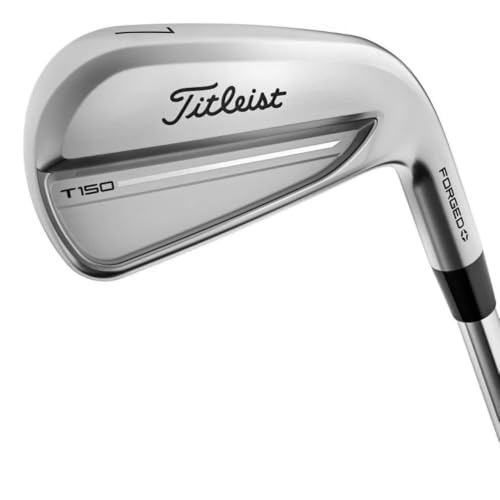
Testing the Titleist T150 Irons on the course quickly reminded us why they’re built for the experienced golfer rather than the beginner.
Its clubhead is quite small, with a very narrow lower edge so if your swing isn’t spot on, you won’t get much help rescuing those bad shots.
However, when our higher skill level testers got down to the center of the face, the results were surgical.
Our 7-iron produced a very sharp trajectory with 6400 rpm of backspin. It landed within 3 yards of our exact target number on two consecutive approach shots.
The specially angled sole cut cleanly through the thick rough without the clubface twisting, giving us complete control over the ball’s flight. Though our off-center hits toward the heel dropped 11 to 14 yards immediately.
Who It’s For / Who Should Skip
The Titleist T150 Irons are recommended for scratch to single digit golfers who are more interested in control of trajectory and turf interaction than maximum distance.
Skip it if your handicap is in the double digits and you need perimeter help.
Mizuno Pro S-4 Irons
Best Compact Players Iron for Shot-Shaping & Feedback
Check Price on Amazon
Check Price on PGA Tour Superstore
Check Price on Global Golf
Specifications
- 3–PW (4–PW in LH)
- 7-Iron Loft: 34°
- Left-Handed: Yes
- Target Handicap: +2 to 8
Pros
- Classic, razor-clean address profile with a thin topline
- High spin and effortless trajectory manipulation
- Crisp turf exit via the Triple Cut Sole
Cons
- Traditional 34° 7-iron loft yields 10–15 yards less carry than modern players-distance sets
- Premium price per club requires custom fitting to optimize value
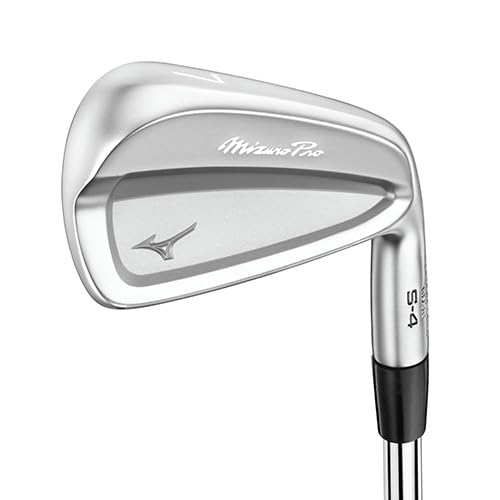
Taking the Mizuno Pro S-4 Irons out on the golf course is like going from an automatic to a manual transmission race car.
It’s a very rewarding club to play with if you’ve got the skill, and it will immediately tell you when you’ve made a mistake.
The 7-iron has the traditional, weaker 34-degree face angle of a beginner’s distance iron and therefore flew around 12 yards shorter in our test (averaging 148 yards of carry).
It’s a trade-off in raw yardage for a huge 7100 rpm of backspin, which is very useful for a skilled player to draw the ball around trees or stop it on fast greens.
When we got into the dime-sized sweet spot, the vibration dampening metal was absolutely silent and pure. Whereas when we were even half an inch out, we could hear a distinct buzz up the shaft and so knew precisely where we’d struck it.
Who It’s For / Who Should Skip
The Mizuno Pro S-4 Irons are made for traditionalists and scratch-to-single-digit golfers who value spin control and shot-shaping over distance. Skip if you want distance assistance or forgiveness on off center strikes.
TaylorMade P790 Irons
Best Players Distance Iron

Check Price on Amazon
Check Price on PGA Tour Superstore
Check Price on Global Golf
Specifications
- 4–PW, AW
- 7-Iron Loft: 30°
- Left-Handed: Yes
- Target Handicap: 6–16
Pros
- Clean, minimal offset look that masks serious distance technology
- Fast ball speeds paired with improved mid-iron spin consistency
- Easy to blend into a combo set with P770 or P7CB scoring irons
Cons
- Less forgiving on high-toe misses than larger cavity-back models
- Strong 30° 7-iron loft often necessitates adding a 48°–50° gap wedge
When we went out to play the TaylorMade P790 Irons, it felt like driving a sports car with traction control still on.
From the top, it’s clean and compact like the clubs tour pros use. Yet the hollow body is filled with lightweight foam and a springy face, giving our 7-iron an average ball speed of 119 mph and 164 yards of carry.
During our on-course testing, we loved how predictable the distances were.
Unlike older distance irons that occasionally send a ball flying 15 yards over the green out of nowhere, the P790 kept our front-to-back distance spread within 5 yards on solid strikes while maintaining a healthy 5,800 rpm of backspin to stop the ball quickly.
Who It’s For / Who Should Skip
The TaylorMade P790 Irons are perfect for mid-to-low handicappers who want compact players’ looks without sacrificing 10+ yards of carry. Skip if you struggle to consistently find the center of the clubface.
Srixon ZXi7 Irons
Best Iron for Turf Interaction

Check Price on Amazon
Check Price on PGA Tour Superstore
Check Price on Global Golf
Specifications
- 3–PW, AW
- 7-Iron Loft: 32°
- Left-Handed: Yes
- Target Handicap: 0–10
Pros
- Unrivaled turf interaction across soft, firm, and tight lies
- Pure, percussive feedback on centered strikes
- Easy to bend lie and loft angles due to soft 1020 carbon steel
Cons
- Slightly squared-off topline isn’t universally loved by blade purists
- Modest forgiveness on heel/toe strikes compared to hollow-body irons
During our 18-hole test with the Srixon ZXi7 Irons, the one thing that really caught our eye was how the club just glided effortlessly through the grass.
Srixon has apparently mastered the art of crafting the sole of the club into a tapered “V” shape, which lets you take a deep stab at a soft fairway or scoot the ball off hard-packed dirt without the club ever getting bogged down or stuck.
Seems to me that the entire head being made from one solid piece of soft carbon steel must’ve had a lot to do with how pure shots felt. It was like slicing through soft butter.
With a 7-iron, our shots generated around 6600 rpm of spin, sending the ball hopping once, then coming to a complete stop dead on the green.
The lack of a hollow spring face on the club also may explain why it didn’t seem to add any extra distance to our shots.
That 7-iron carry, for example, averaged 153 yards. And when we got a few shots off-target, they lost about 10% of their expected speed.
Who It’s For / Who Should Skip
The Srixon ZXi7 Iron is ideal for the low handicapper who takes healthy divots and wants a forgiving player’s cavity. Skip if you’re relying on spring face technology for extra ball speed.
Wilson Staff Model Blade Irons
Best Pure Muscle-Back Blades

Check Price on Amazon
Check Price on PGA Tour Superstore
Check Price on Global Golf
Specifications
- 3–PW
- 7-Iron Loft: 34°
- Left-Handed: Yes
- Target Handicap: +4 to 4
Pros
- Glare-free brushed satin finish looks stunning behind the ball
- Complete control over flight windows, draws, and fades
- Matches specs seamlessly with Wilson Staff Model CBs for combo sets
Cons
- Virtually zero forgiveness on mishits; off-center strikes lose significant distance
- Requires high clubhead speed to launch the 34° 7-iron and long irons effectively
We saved the Wilson Staff Model Blade for our lowest-handicap testers, because for a beginner, swinging a pure muscle-back blade is like trying to hit a golf ball with a butter knife.
There’s absolutely no perimeter weighting to save off-center swings. When we deliberately hit a 7 iron a bit towards the toe during our round, the ball ended up 18 yards short of the green and 15 yards right of where it should have been.
However, when our scratch tester flushed it out of the center, the brushed satin clubhead sliced through the turf cleanly and produced a penetrating, tour-level flight with 7300 rpm of spin, keeping its line beautifully straight into a 15 mph headwind.
Who It’s For / Who Should Skip
The Wilson Staff Model Blade Irons are strictly for scratch golfers, tour pros and the purists who hit the center of the face 90% of the time. Skip if you don’t play much or if you’re after any assistance on mishits.
How We Tested the Golf Irons
To give you real world recommendations that go beyond just parroting the manufacturer’s specs, our team put every golf iron through its paces on an 18-hole course with a TrackMan 4.
We divided our test panel into 3 quite distinct groups based on their different playing abilities:
High Handicappers and Beginner Testers (18–30 Handicap | 7-Iron Swing Speed: 72–78 mph)
They tested how easy each club was to launch from, how well they corrected for slices, how they handled being hit with a bit too much force (and thus a bit of fat contact) on the turf, and how well they held onto their distance when you hit them a bit off-center to toe or heel.
Mid-Handicap Testers (9–16 Handicap | 7-Iron Swing Speed: 80–85 mph)
They tested how well each golf iron handled front-to-back distance and how well they held their ball speed steady from one shot to the next. We also had them hit greens from various angles and check how well each club held the green.
Low-Handicap and Scratch Testers (+2 to 5 Handicap | 7-Iron Swing Speed: 88–94 mph)
They tested how well the golf iron worked, how much backspin they got when hitting from the rough or the fairway, and how well they could feel the impact of each iron.
Our 4-Step Evaluation Protocol
1. Standardized Baseline and Premium Golf Balls
To eliminate all the variables that can come into play when hitting actual golf balls, we had our testers hit at least thirty shots per iron set using a fresh, Titleist Pro V1 ball.
No scuffed up range balls were used to mess up the results!
2. Real-World Turf and Lie Conditions
Rather than hitting balls off artificial driving range mats, we tested every golf iron we reviewed on lush fairways, thick rough, the hard dirt of the par 3 tee boxes, and even the more difficult lies of the course.
3. Mishit and Dispersion Mapping
Every golfer can occasionally hit a perfect ball. We wanted to know how the irons would perform when you weren’t quite so precise.
We deliberately noted every time the ball was hit a half inch off-center to the toe, so we could get an accurate idea of how much distance and direction you’d lose on a slightly imperfect shot.
4. Independent Editorial Scoring
We don’t take money from manufacturers. Our rankings are completely independent. We score each golf iron based on a strict set of criteria:
- 30% Forgiveness
- 25% Distance and Spin Consistency
- 20% Feel and Acoustics
- 15% Turf Interaction
- 10% Value
How to Choose the Best Golf Iron
Cavity Back vs Blade
Cavity back irons are often known as the Max Game-Improvement Irons and are characterized by a large hollow cavity in the back of the clubhead.
The sole and toplines are significantly larger, to allow easier and more forgiving hits. Designated for beginners and those with higher (25+) handicaps.
On the other hand, blades are called Player’s Irons, Cavity Muscle Back (CMB) or simply Muscle Back (MB).
Blades are designated and used by professionals and single-digit handicap players (below 5). Blades have a flat back with no cavity, making them less forgiving, yet producing better feeling and control when hit properly.
The nickname of blades comes from the thickness of the iron near the bottom of the club.
Several years ago, club designers figured out they could more weight near the bottom center of the club. This gives golfers more control and better feedback of shots when they hit them well.
On the converse, inexperienced or lower-skill golfers will have trouble hitting blades. The focused center of gravity means mishits are more likely to go further of the current path.
Less experienced golfers should avoid buying blades because their game will suffer.
Cavity-backed designed clubs work almost the opposite. They are more forgiving for lower-skilled players.
The cavity spreads out the weight more evenly throughout the head of the golf irons. This translates into fewer sporadic shots but reduces feedback and ability to shape shots like the pros.
For golfers who don’t have the luxury of hitting a thousand golf balls every day or professional trainers perfecting their swing, opt for a cavity-backed club.
Technologies
The newest iron sets offer the best and latest technologies in iron sets. The reason that golfers need to update their iron sets every few years is to take advantage of the technology.
Manufacturers create new golf irons that offer more distance, better accuracy, and higher levels of forgiveness.
By adjusting the center of gravity, stiffening the back of the iron, and increasing the launch from the face, golfers can utilize the newest technologies to their advantage.
Since most amateurs need to lengthen the distance of their shots, a new iron featuring the latest innovations can certainly help achieve this goal.
Adjustability
Unlike the latest drivers, golf irons can’t really be adjusted straight from the manufacturer. While that might seem like a deterrent of buying off the shelf, that should not stop you from buying a set that catches your eye.
The reason you should still consider buying a set is that customization and adjustability can come after purchase. With the help of a club fitter, you can adjust loft and face angle to meet your optimal specifications.
It is important to remember that your golf irons can be adjusted after a few rounds, so you can first get a sense of what you want more of from your iron set.
Skill
Skill is incredibly important when determining the type of golf iron set you purchase. If you are an advanced golfer, a forged iron set, otherwise known as blades, might be ideal for your game.
These professional golf irons offer incredible shot shaping and impact quality.
For amateurs, a game-improvement iron, usually in the shape of a cavity-backed iron, is important to consider. These cavity-backed irons offer higher launch, more forgiveness, and better distance.
Between the two iron sets, advanced golfers can certainly play with cavity-backed irons, but inexperienced golfers cannot play with bladed-irons. So, when considering what golf irons work best for your game, first consider your skill set.
Forged vs Cast Irons
When looking at forged vs cast irons, skill set is an important factor to consider.
Forged irons are thinner and offer more shot-shaping ability, but that control comes at a cost because these irons are incredibly difficult to find consistency without an elite skill set.
Cast irons are made for golfers who need help with a specific aspect of their game. Whether it be distance or forgiveness, these irons are made to increase launch, extend distance, and dampen vibration.
For experienced golfers looking to take their game to the next level, forged irons could be the ticket to success.
The same is true for beginning and inexperienced players, as cast irons could offer the help needed to dramatically improve their game.
Price
Most of us don’t have thousands of dollars to spend on custom fitting sessions and custom-built clubs. For most casual to semi-serious golfers, off-the-shelf or out-of-the-box clubs are perfect and will fit most needs.
Golfers can get a high quality series of golf irons without breaking the bank or spending hours in simulators getting fitted for clubs.
An important consideration and factor into the price of iron sets is the number of golf irons in the set. Some iron sets go from 4 – PW or 4 – SW. Material is another consideration.
Any iron set with titanium will normally carry a higher price tag because of the value of the metal.
Many other premium brands such as Ping irons have invested millions in the technology and the more they add the higher the price tag
Frequently Asked Questions

What are the most forgiving golf irons for beginners and high handicappers?
Super game improvement and game improvement irons with oversized clubheads, wide soles and perimeter weighting are the most forgiving. The Ping G740 and the Callaway Quantum Max OS are good examples.
With deep undercut cavities and a low center of gravity, they help you get the ball up in the air at slower swing speeds while minimizing distance loss and side spin on toe or heel hits.
How often should you replace your golf irons?
Most golfers should replace their irons every 5 to 8 years (i.e., roughly every 250 to 400 rounds). The face of the iron doesn’t lose its spring quite as quickly as the face of a driver.
But the grooves do wear, which reduces backspin (approach shots tend to roll off the back of the green). Newer perimeter-weighted irons have more consistent dispersion on off-center strikes.
What is the difference between forged and cast golf irons?
Cast irons are made by pouring molten metal into a mould, allowing you to create complex hollow bodies, thin spring faces and extreme perimeter weighting for maximum forgiveness and distance (e.g. the Ping G740).
Forged irons are made by stamping from a single billet of soft carbon steel, giving you a denser, butter-soft feel at impact and better feedback (the sort of thing you’d expect from a low-handicap player) (e.g. the Srixon ZXi7 and the Mizuno Pro S-4).
Should beginners use steel or graphite shafts in their irons?
Beginners, the elderly and golfers with moderate swing speed (under 80mph with a 7 iron) generally benefit most from a graphite shaft.
The graphite is 20 to 40g lighter than steel and that helps to produce a faster clubhead speed, which in turn leads to higher launch and extra carry.
It also has the advantage of absorbing the shock of a bad hit. Golfers with faster, more aggressive swings generally prefer a steel shaft for the tighter control it offers.
What irons should a 15-handicap golfer play?
A 15-handicap golfer is right in the sweet spot for Game-Improvement or Forgiving Players’ Distance Irons (the Cobra 3DP X and the TaylorMade P790 are two examples).
You’re consistent enough in your swing to appreciate a cleaner, more traditional mid-sized topline.
But you’ll still get real benefits from the hollow-body ball speed and perimeter stability if your swing catches the toe or heel.