Updated November 19, 2026. This article was thoroughly audited by multiple golf experts and coaches for its accuracy. You can read more about our rigorous testing protocol here.
Blade irons are designed for skilled players who want more control and feedback from their shots.
Unlike cavity-back irons, which have a hollow space behind the clubface, blade irons have a solid back and a thin face.
This means that blade irons have a smaller sweet spot, a higher center of gravity, and more weight distribution along the clubface.
Blade irons can help you shape your shots better, hit more precise distances, and feel more connected to the ball. However, they are not for everyone.
They require more accuracy and consistency and can be less forgiving of mishits.
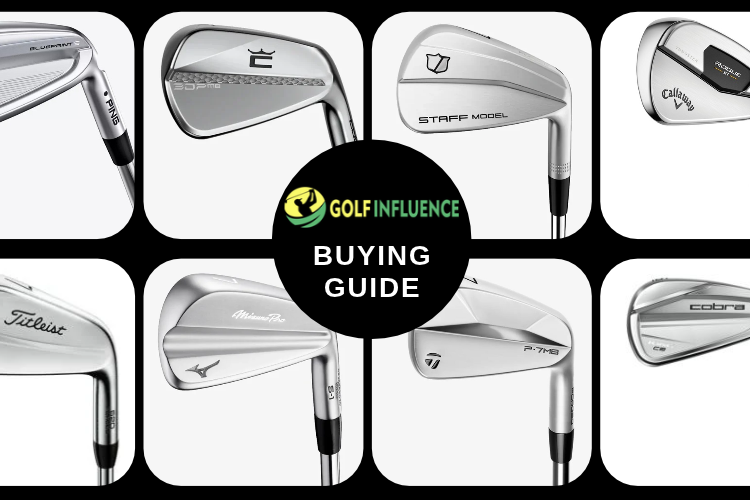
If you’re ready to take your game to the next level, blade golf irons can be a great investment. Here are our top 8 picks of the best blade irons on the market today.
17
Sources researched
15,948
customer
reviews
8
products
tested
Featured Recommendations


Last updated on 2026-11-23. The links are affiliate links. Product images are served from Amazon Product Advertising API.
Table of Contents
Best Blade Irons 2026
Cobra 3DP MB Irons
Best Forgiving Blade Iron
Specifications
- Loft: 24°-50°
- Lie: 60.5°-63.5°
- Shaft Length: 35.75″-38.75″
- Swing Weight: D2, D3
Pros
- Unmatched off-center stability and ball-speed retention for a compact muscleback profile
- Tour-validated blade aesthetics at address with a razor-thin topline and minimal offset
- Soft, dense impact acoustics thanks to internal lattice vibration tuning
Cons
- High perimeter MOI slightly dampens extreme shot-shaping compared to a traditional one-piece forging
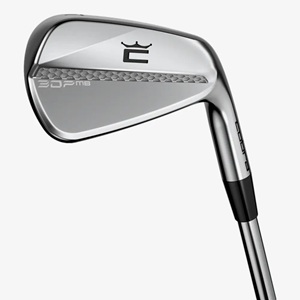
Blades aren’t meant to bail you out on a thin strike, which is why the Cobra 3DP MB broke almost every rule I’d expect from a muscleback during testing.
By 3D printing the head from 316 stainless steel they’ve hollowed out the inside with a complex lattice structure (something you couldn’t possibly forge) and taken that saved mass and put it into high density tungsten weights in the heel and toe.
At address, the compact heel to toe, the boxy toe and the razor thin topline are very much the look of a tour level butter knife.
When I went out and hit the 7-iron (34° loft) on the launch monitor and out for 36 holes, the stability on off-center hits was very obvious.
On center hits with a 91 mph 7-iron swing speed, we were averaging 168 yards of carry, launching at 18.2° with 6,650 RPM of spin. Again, numbers were very much in line with the traditional tour blade.
Where it separated itself was on the 10mm toe miss. Rather than the typical 12 to 15 yards drop of a conventional forging, ball speed only declined by 1.8mph, maintaining around 161 yards of carry with a very tight left to right dispersion.
Impact is a very dense, quite soft ‘thud’ actually. The perimeter weighting does make very deliberate hooks and fades a bit harder to turn over than you would with a pure one-piece forging.
Who It’s For & Alternatives: The Cobra 3DP MB is built for mid-to-low handicap ball-strikers (3–10 handicap) who crave the compact look and trajectory control of a true blade but need discreet perimeter stability for days when their swing isn’t dialed in.
If you’re after similar multi-material forgiveness in a compact player’s footprint without quite paying nearly $2,000 for six clubs, look at the Titleist T100 or the Cobra 3DP X.
Wilson 2026 Staff Model Blade Irons
Best Purest Shot-Shaper
Check Price on Amazon
Check Price on PGA Tour Superstore
Check Price on Global Golf
Specifications
- Loft: 20°-46°
- Lie: 59.5°-64°
- Shaft Length: 35.75″-39.25″
- Swing Weight: D2
Pros
- Surgical workability and trajectory control in both directions
- Precision-milled face boosts spin consistency and stopping power on firm greens
- New brushed satin finish eliminates the sun glare of older chrome models
Cons
- Razor-thin sole and compact blade length leave almost zero margin for mishits
- Noticeable harsh feedback in the hands when striking outside the sweet spot
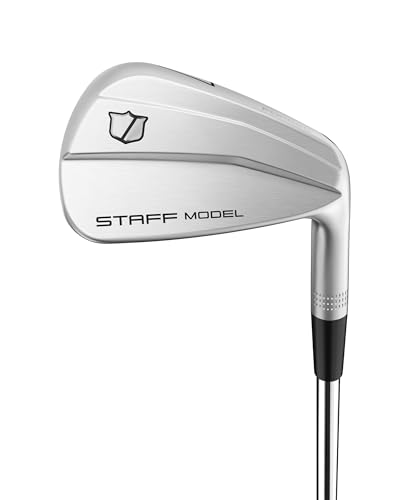
The Wilson 2026 Staff Model Blade Iron is a pure, unashamed tour bred muscleback designed for total trajectory control.
For the 2026 release, Wilson swapped out the mirror chrome of previous generations for a sleek brushed satin finish that removes sun glare at address.
The blade has also been shortened, and the offset tightened for an ultra compact, nimble profile.
Under the hood, the Fluid Feel Hosel removes some of the weight from the heel and moves it toward the toe to get the center of gravity perfectly aligned with the sweet spot.
In our testing, the precision-milled face pattern was far from just a cosmetic feature. It really did make a difference.
The ball worked both ways with the 8-iron and the 7-iron as easily as you could ask for. Whether you were playing a low knockdown fade into a crosswind or a high draw that just stopped dead on landing.
My 7-iron numbers sat at 166 yards of carry with a very high, predictable 7,210 RPM spin rate and very tight front to back yardage gaps.
The sole is very narrow and the perimeter weighting is minimal, so there’s absolutely zero mercy on mishits. A half-inch catch toward the toe was a sharp sting up the shaft and cost me nearly 14 yards of carry.
Who It’s For & Alternatives: The 2026 Wilson Staff Model Blade is exclusively for the very top end of the game (0–3 handicap, 95+ mph driver swing speed) who hit the center of the face consistently and are looking for a blade that gives them absolute control over their spin and flight windows.
If you’re after that same compact address profile and soft 8620 forged feel with a bit more stability on off-center strikes, then go for the Wilson 2026 Staff Model CB.
It has the same specs and same stock shafts as the 8620, so it will blend perfectly into a combo set.
Mizuno Pro S-1 Irons
Best Feel & Turf Interaction
Check Price on Amazon
Check Price on PGA Tour Superstore
Check Price on Global Golf
Specifications
- Loft: 24°-46°
- Lie: 60.5°-63.5°
- Shaft Length: 35.75″-38.75″
Pros
- Unrivaled tactile feedback from single-billet 1025E carbon steel and a copper underlay
- Tour-confirmed sole geometry glides cleanly through lush or soft turf without digging
- Glare-free Soft White Satin finish frames the ball cleanly in bright sunlight
Cons
- Punishing distance loss on thin or toe-side strikes, especially in the 4- and 5-irons
- Traditional 34° 7-iron loft requires high clubhead speed to maintain proper gapping
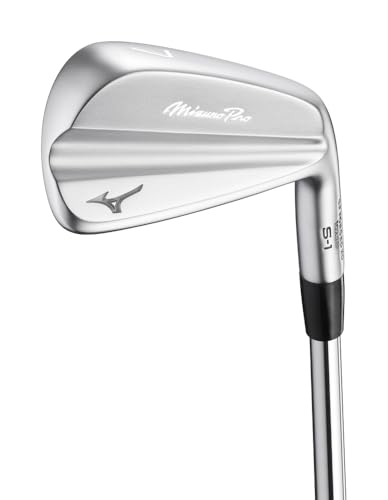
Nothing in golf really replicates the feel of a pure Mizuno forge. The Mizuno Pro S-1 takes that formula and tweaks it very subtly and it completely changed the way the club moved through the turf for me.
Forged in Hiroshima from a single billet of 1025E mild carbon steel with a thin copper underlay and a glare-free Soft White Satin finish.
The S-1 has a shallow channel cut right above the muscle, which does push the mass slightly higher behind the hitting zone, giving the club a firmer, denser tour-validated feel rather than a mushy one.
During our range and on-course testing with the Nippon Modus 120 Stiff shafts, the big ‘aha’ moment wasn’t so much the sound as it was the tour-confirmed sole.
Mizuno have flattened the sole camber, sharpened the leading edge and added a bit more bounce.
As I have a fairly steep angle of attack, the standard narrow blades can sometimes dig into soft fairways. The S-1 went in and out of the turf absolutely effortlessly, taking only shallow, dollar bill sized divots.
On TrackMan, my 7-iron (34°) produced 165 yards of carry, a very sharp 17.1° launch angle and 7,050 rpm of backspin. That let me to fly shots downwind and hold the greens very easily.
Who It’s For & Alternatives: The Mizuno Pro S-1 is absolutely the ball for the scratch to 4 handicapper and the steep swinger who wants the feel of the club, the crispness of turf interaction, and traditional lofts rather than any distance assist.
If you’re a fan of Mizuno’s signature copper underlay softness but find your strike pattern drifting towards the heel or toe in the 4s to 6s, then you might want to consider mixing the S-1 scoring irons with the slightly more forgiving Mizuno Pro S-3 cavity backs in the top end of your set.
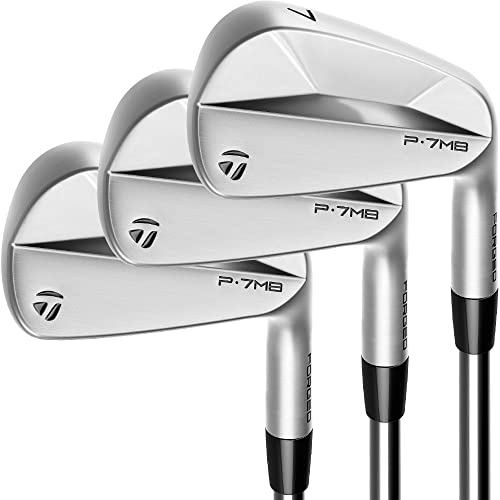
TaylorMade P7MB Irons
Best Blade Iron for Shot Control
Check Price on Amazon
Check Price on PGA Tour Superstore
Check Price on Global Golf
Specifications (4-PW)
- Loft: 24°-47°
- Lie: 61°-64°
- Shaft Length: 35.75”-38.50”
- Swing Weight: D3, D4
Pros
- Compact design with optimal blade length
- Superior shot control
- Exceptional feel
Cons
- Less forgiving than other irons
The TaylorMade P7MB Irons are the epitome of a golfer’s dream. These blade golf clubs offer a compact design, an addictive feel, and most importantly, unrivaled shot control.
With a five-time forged 2000-ton press construction, a soft copper underlay in the face, a thin topline, and minimal offset, these irons are masterfully crafted to deliver precision and workability on the golf course.
However, their full potential is realized when used by skilled players.
During our testing round, we were able to achieve three consistent shots with these irons, experiencing a thrilling mix of control and power.
If you’re a blade purist or a highly skilled player, the TaylorMade P7MB Irons are a must-try.
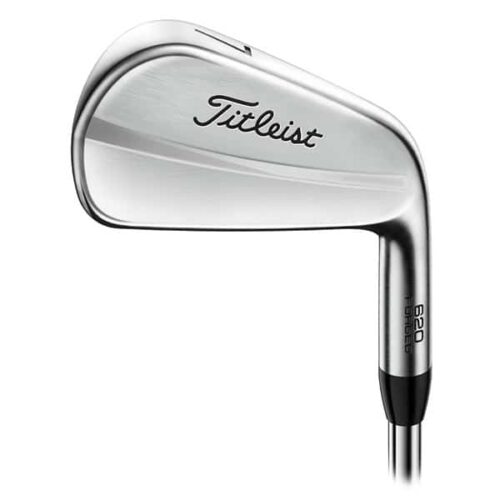
Titleist 620 MB Irons
Best Golf Irons for Consistent Results
Check Price on Global Golf
Specifications
- Loft: 21°-47°
- Lie: 60°-64°
- Shaft Length: 35.5″-39″
- Swing Weight: D2
Pros
- Excellent for consistent results
- High level of precision
- Superior control and feedback
Cons
- Not high handicap golfers
For golfers who prioritize shot control and consistent results, the Titleist 620 MB Irons are an excellent choice.
These precision irons feature a classic compact muscle back head, minimal offset, and a thin topline, all contributing to their consistent performance.
As we tested these irons, we found them to be incredibly reliable, delivering consistent results with every swing.
However, much like the Callaway Apex MB Irons, the 620 MB is designed for the “golfing purist.” They require a high skill level and are best suited for accomplished ball strikers.
So, if you have a low handicap and value consistency, the Titleist 620 MB Irons might be the perfect fit for you.
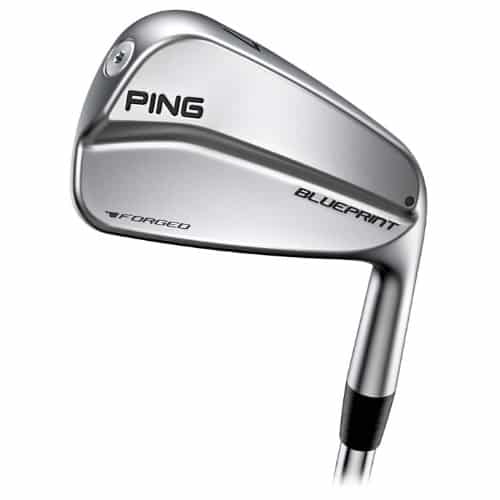
Ping Blueprint Irons
Check Price on Global Golf
Specifications
- Loft: 22.5°-45°
- Lie Angle: 59.8°-64.1°
- Shaft Length: 35.5”-38.25”
- Weight: D2
Pros
- Narrow sole provides premium workability
- Machined-milled grooves boost spin
- Impressive feel and responsiveness
Cons
- Compact blade length makes consistency difficult
Ping’s exciting Blueprint irons offer a top-tier set of blades for advanced golfers. These compact irons carry a muscle-back design to maintain long distances with high-yield workability.
The Blueprints also deliver a smooth feel and responsiveness with crisp turf interaction. The irons provide forgiveness on off-center strikes, something you rarely see with blade iron sets.
We really loved how capable these Ping irons are to play on the course. From workability to distance, the Blueprint delivers premium performance across the board.
With regard to spin and launch, the Ping set produces first-rate readings on the Trackman.
Again, blade sets, such as the Blueprint irons are harder to hit for golfers with double-digit handicaps. But for low handicappers, these Ping golf clubs offer premium workability and staggering distance.
Cobra King MB Irons
Best Golf Blade Irons for Control

Check Price on Amazon
Check Price on PGA Tour Superstore
Check Price on Global Golf
Specifications
- Loft: 21°-50°
- Lie: 60°-63.5°
- Shaft Length: 35.75″-39.25″
- Swing Weight: D2, D3
Pros
- Superior control
- Enhanced stability and forgiveness
- Solid feel and feedback
Cons
- Not suitable for high handicappers
The Cobra KING MB golf irons are the epitome of control and stability.
These high-performance irons feature a classic blade design, a minimal offset, and a clean look that inspires confidence at address. It has a forged carbon steel construction for exceptional feel and feedback.
These forgiving irons are ideal for skilled golfers who require precision and control.
They provide a unique mix of performance and forgiveness, making them a great choice if you’re an experienced golfer aiming to improve your control on the greens.
We recommend the Cobra King MB Irons if you want to achieve more accuracy with your shots, fine-tune your distance control, or if you want to shape your shots with ease.
Callaway Rogue ST Pro Irons

Check Price on Amazon
Check Price on PGA Tour Superstore
Check Price on Global Golf
Specifications
- Loft: 21°-43°
- Lie Angle: 60.5°-63.5°
- Shaft Length: 35.75”-38.5”
- Swing Weight: D3
Pros
- Delivers exceptional ball speed, distance and accuracy
- Feels soft and responsive on impact, with a satisfying sound and feedback
- Sleek and compact design that looks great at address
Cons
- Not very forgiving, a consistent and precise swing is needed to get the most out of them
The Callaway Rogue ST Pro Irons are one of the best golf blade irons we have ever tested. They combine cutting-edge technology with a classic look and feel.
They are designed for low-handicap players who want to maximize their performance and control. They offer incredible speed, distance and accuracy, as well as a smooth and solid feel.
They are not for beginners or high-handicappers, as they require a lot of skill and consistency to hit well. They are also on the pricey side, so you need to be willing to invest in them.
If you are looking for a set of blade golf clubs that will take your game to the next level, we highly recommend the Callaway Rogue ST Pro Irons.
They are ideal for players who have a fast swing speed, a high ball flight and a preference for workability and precision.
How We Tested the Blade Irons
Blade irons are a bit trickier to test than most irons because only a select number of golfers can accurately evaluate them when swinging the golf club.
Since these are specialized golf clubs, you need advanced players, such as low handicappers, to get accurate results from them.
Before we hit the irons, we evaluate the design of each set.
With blade irons, the actual blade is smaller and more compact, so we want to see the groove system and the hitting area. Since these irons offer little forgiveness, the size of the hitting area is significant.
After our initial evaluation, we took the blades to the indoor hitting area to collect data for the indoor launch monitor.
We’re looking for distance, ball speed, dispersion, and launch angle with blade irons because we want the golf ball to have a low-penetrating flight from these types of irons.
Outside, we want to see workability in action with each set. Since blade irons are known for their consistent ball flight, controlling shot shape can make or break the final score for each iron collection.
Once all the hitting sessions are complete, we return to the lab to share notes and make our final evaluations for this list of the best golf blade irons.
How to Choose the Best Golf Blade Irons
Forgiveness
Blade irons are less forgiving than cavity back or game improvement irons, which means that any mishits will result in more distance and accuracy loss.
If you have a consistent and reliable swing, you might not mind this trade-off. But if you struggle with consistency or confidence, you might want to look for more forgiving irons.
Feel
Blade golf clubs offer superior feel and feedback compared to other types of irons, which can help you improve your ball striking and shot shaping skills.
You will be able to feel the difference between a pure strike and a slight miss, and adjust accordingly. However, some golfers might find the feel too harsh or unfriendly, especially on off-center hits.
Workability
Blade irons are more workable than other irons, which means that you can manipulate the ball flight and trajectory more easily.
This can be an advantage if you like to shape your shots around obstacles or different wind conditions, or if you want to hit different types of shots with the same club.
However, some golfers might prefer more stability and consistency in their ball flight, and avoid unnecessary complications.
Appearance
Blade irons have a sleek and classic look that many golfers find appealing. They have a thin top line, a narrow sole, and a compact head that inspires confidence at address.
They also have less offset than other irons, which can help you align your clubface better with your target.
Price
Blade irons are usually more expensive than other types of irons because they require more precision and craftsmanship to produce.
They are also less durable than other irons because they are made of softer materials that wear out faster.
If you are willing to pay a premium for performance and quality, blade golf clubs might be worth it, but if you are on a budget or looking for value, you might want to consider other options.
Frequently Asked Questions

What are the easiest blade irons to hit?
The Ping Blueprint Irons stand out as notably forgiving for a blade set. We found their design provides surprising stability and forgiveness on off-center strikes, a rare trait in this category.
These irons are best for skilled golfers (typically low single-digit handicaps) who demand shot-shaping control but appreciate a touch more leniency than traditional blades offer.
Who makes the best blade irons?
Mizuno is consistently lauded by golfers for their exceptional feel and craftsmanship. Their meticulous forging process creates a soft, buttery sensation at impact that’s unmatched, making them a top choice for purists seeking ultimate feedback and control.
What handicap should play blade irons?
Blade irons are generally recommended for low-handicap golfers, typically those with a handicap of 5 or lower. These players possess the consistent ball-striking ability required to find the small sweet spot, maximizing the blade’s precise control and workability.
What are blade irons better for?
Blade irons are primarily better for shot-shaping and feel. Their compact design and minimal forgiveness allow skilled players to intentionally curve the ball, control trajectory, and receive immediate, unadulterated feedback on every strike.