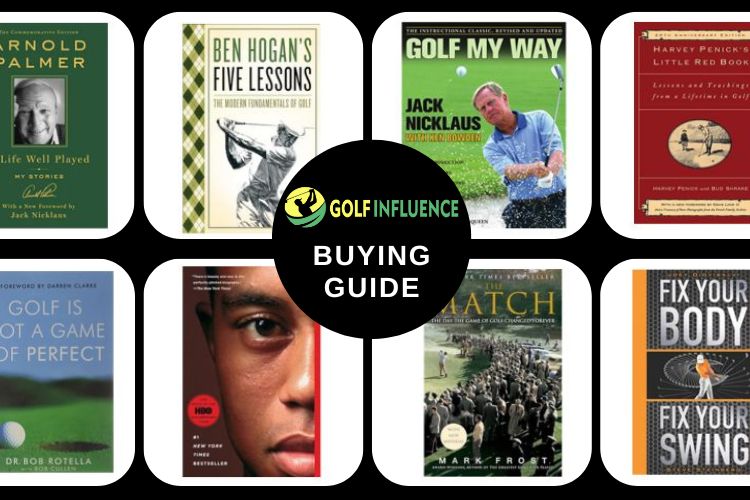
Updated November 18, 2026. This article was thoroughly audited by multiple golf experts and coaches for its accuracy. You can read more about our rigorous testing protocol here.
The best golf books don’t just fix the slice, they take you through the swing mechanics, the course management and the mental toughness that separate casual players from legends.
Whether you’re after step by step instruction on how to reduce your handicap or simply some inspiring biographies of the greats (Arnold Palmer, Jack Nicklaus and Tiger Woods amongst them), the right book will completely change the way you go about every single 18-hole.
We’ve put together the top 15 books that every golfer should have in their shelf.
From the all time classic technical manuals through to the very best in sports psychology, and some truly excellent stories from the game itself.
These are the books that will genuinely help you to improve your game and understanding of the sport.
29
Sources researched
17,325
customer
reviews
15
products
tested
Featured Recommendations


Last updated on 2026-11-22. The links are affiliate links. Product images are served from Amazon Product Advertising API.
Best Golf Instruction & Swing Mechanics Books
Ben Hogan’s Five Lessons: The Modern Fundamentals of Golf
Best for Full-Swing Fundamentals

Written in 1957 by nine-time major champion Ben Hogan, this 128-page manual is the undisputed bible of golf instruction. It gets rid of all that confusing swing thinking and focuses on four repeatable building blocks.
Why it made the list: Rather than trying to overwhelm the amateur with a whole raft of swing theories, Hogan simply breaks the golf swing down into four fundamentals: the grip, the stance and posture, the first part of the swing and the second part of the swing.
Paired with Anthony Ravielli’s classic anatomical drawings, you can see precisely how the muscles and joints should be aligned on each page, making it very easy to go straight from your living room to the driving range.
Even 60 years on, the touring pros and the teaching pros will still refer to Hogan’s grip and swing plane checkpoints when looking at a player’s ball striking problems.
If you’re struggling with an inconsistent slice or with weak contact in general, just going through the first 40 pages will immediately reduce your dispersion.
Biggest takeaway: The “glass pane” swing plane visualization—imagining a sheet of glass resting on your shoulders and angled to the ball so your arms stay on plane without breaking through.
Who should skip it: Skip Ben Hogan’s Five Lessons if you’re after short game, bunker or putting instruction as Hogan is solely focused on the full swing from tee to green.
Dave Pelz’s Short Game Bible
Best for Scoring Inside 100 Yards

Backed by Dave Pelz’s (former NASA physicist) decades of launch data and tour research, this is the most comprehensive, science-based guide ever written on how to eliminate the wasted stroke around the green.
Why it made the list: More than 60% of golf shots are taken within 100 yards of the hole, and yet the vast majority of amateurs spend 90% of their practice time hitting drivers.
Pelz proves again that the fastest way to get under 80 is to have total control of spin, trajectory and landing speed.
He introduces his well known ‘clock system’ (7.30, 9.00 and 10.30 backswings) across 3 or 4 wedges so you can dial in your exact carry yardage rather than having to guess.
Found in the bookshelves of literally thousands of PGA and LPGA pros, the book takes the guesswork out of tricky lies, wet bunkers and tight fringe chips.
Once you’ve built your own personal wedge matrix using Pelz’s testing methodology, scoring in the 100-yard range becomes purely mechanical rather than a stressful proposition.
Biggest Takeaway: The 3×4 Wedge System—using three repeatable backswing lengths across four wedges to create 12 exact, reliable carry distances inside 100 yards.
Who should skip it: Skip Short Game Bible if you’re after a quick, easy read, as it’s nearly 450 pages long and reads like an engineering textbook. You’re going to need a significant amount of practice time to get anything done from it.
Golf My Way by Jack Nicklaus
Best All-In-One Technical Manual

Written by 18-time major champion Jack Nicklaus, this is a complete manual covering every physical and tactical aspect of the game with excellent step by step illustrations.
Why it made the list: it’s not some book that’s going to tell you one little thing about your swing.
Golf My Way takes you through Nicklaus’s entire system from club selection and alignment right through to the art of the intentional fade and draw, how to escape a trouble lie and how to deal with risk under tournament pressure.
Every technical concept is supported by clear sequence drawings which illustrate weight transfer, head stability and clubface control.
What’s distinctive about Nicklaus’s approach is his focus on playing within your own natural shot pattern rather than attempting to achieve some mythical ‘perfect’ swing.
The amateur who is prepared to do some genuine range work will walk away with a complete system for building a repeatable, pressure-tested game.
Biggest takeaway: Master one reliable stock shot shape (Nicklaus favored a controlled fade) and align your setup to eliminate one side of the golf course.
Who should skip it: Skip Golf My Way if you’re after some modern, pared down swing advice.
Nicklaus’s approach is very much one of the old school. It’s absolutely the sort of thing that will only really work for a player who is prepared to go in and study the details.
Harvey Penick’s Little Red Book
Best Timeless Lessons & Simple Tips

Taken directly from the personal spiral notebooks of the legendary Austin teacher Harvey Penick (mentor to both Tom Kite and Ben Crenshaw), this bestseller is a collection of nuggets of wisdom in warm, unadulterated, jargon-free prose.
Why it made the list: Published in 1992, Harvey Penick’s Little Red Book became the best selling sports book of all time because every chapter is just one or two pages long and it reads like advice from a grandfather sitting next to you on the practice tee.
Rather than get into all the complicated body angles, Penick uses simple mental pictures (take dead aim, for instance, or hit a practice swing in slow motion) to fix common amateur errors.
You could read the whole book in a single afternoon or just keep it in your golf bag and flip open a random page before a round. Each anecdote reinforces both smarter shot making and a greater respect for the traditions of the game.
Biggest takeaway: “Take dead aim”—once you pick your target and club, commit 100% to a specific spot rather than steering the ball away from hazards.
Who should skip it: Skip Little Red Book if you’re after biomechanics, TrackMan numbers and the like or if you’re after a very rigid step by step drill. Penick teaches through feel, through simplicity and through intuition.
Tiger Woods: How I Play Golf
Great for Learning Golf From Tiger Woods

Published at the height of Tiger Woods’ ‘Tiger Slam’ dominance, this full color instructional guide reveals the exact setup checkpoints, the practice routines and the shot shaping secrets behind the most dominant golf swing of the modern era.
Why It Made the List: Filled with high-speed sequence photography and clear visualizations, How I Play Golf explains how Woods is able to generate such effortless clubhead speed through sequence and balance rather than upper body strength.
Beyond just driving distance, Woods talks about very practical things like trajectory control (he’ll go into his ‘stinger’ in detail), his greenside bunker play and how he goes about mapping out a course during a practice round.
What really makes the book so good for the amateur is the way Woods explains why he takes the shots he does under pressure.
It’s a massive help to the weekend golfer in terms of getting them to stop just firing blindly at the tucked pins and start playing more high percentage golf.
Biggest Takeaway: Build your swing from the ground up with balanced tempo; swinging at 80% effort with solid center-face contact consistently outdrives an out-of-balance 100% lash.
Who should skip it: Skip How I Play Golf if you’re primarily after an audiobook or e-book, as this title is absolutely at its best as a physical coffee table instructional book (thanks to the photography and diagrams).
Fix Your Body, Fix Your Swing by Joey Diovisalvi & Steve Steinberg
Best for Golf Fitness & Mobility

Written by the highly respected PGA Tour biomechanics guy Joey “Joey D” Diovisalvi, this is a very practical training guide that addresses the physical limitations that cause swing flaws in the first place (tight hips, stiff shoulders, weak core).
Why it made the list: A lot of golfers will spend thousands of dollars on lessons trying to fix an early extension or an over the top move when in fact, the real problem is physical restriction.
Diovisalvi goes through the entire kinetic chain of the golf swing and provides you with a series of step by step corrective exercises that you can do at home or in the gym with very little equipment.
By working on rotational power, glute activation and thoracic spine mobility, you’ll end up with a much wider, more fluid turn. Meaning, you won’t be straining your lower back at all.
Most amateurs will find themselves with loads of effortless extra yardage and a lot less soreness on the back nine within a few weeks of doing the work.
Biggest takeaway: Your swing mechanics are dictated by your physical mobility—unlocking hip and mid-back rotation automatically eliminates common compensations like swaying and casting.
Who should skip it: This is more of a coffee table instructional book because of its photos and diagrams. Skip it if you prefer traditional swing technique tips and stories in audiobook or e-book format.
Best Golf Mental Game & Psychology Books
Golf Is Not a Game of Perfect by Dr. Bob Rotella
Best Overall Mental Game Book

Dr. Bob Rotella (sports psychologist to a who’s who of major champions) has the single most influential mental game ‘playbook’ in golf.
It’s all about teaching the weekend golfer to trust their swing and stop self-sabotaging their rounds through perfectionism.
Why it made the list: Most amateur golfers will kill their scores not because they lack physical ability at all, but because they expect every shot to go straight and then let one double bogey turn into four.
Rotella uses real tour anecdotes and plain mindset shifts to show you how to separate ‘practice mode’ (i.e., looking at the mechanics) from ‘play mode’ (i.e., picking a small target and just reacting in a very athletic way).
Whether you’re playing at a private club or your local muni, simply applying Rotella’s pre-shot commitment and post-shot acceptance rules will go a long way to quelling first tee nerves.
It will help you shave strokes off your handicap without in any way altering your mechanical game.
Biggest takeaway: Become an “exceptional putter” by focusing strictly on picking a precise line, trusting your speed, and never judging yourself by whether the ball drops.
Who should skip it: Skip Golf Is Not a Game of Perfect if you’re after step-by-step mechanical swing drills. Rotella completely eschews the technical mechanics so you can just play.
Zen Golf: Mastering the Mental Game by Dr. Joseph Parent
Best for On-Course Focus & Composure

Blending in classic Buddhist mindfulness principles with actual PGA Tour coaching, Dr. Joseph Parent shows golfers how to quiet the mind, get over a bad hole and stay in the moment on every shot.
Why it made the list: Golf gives you nearly four hours of downtime between shots to go over your swing, work out your score and replay everything you’ve done wrong.
Dr. Parent offers some very simple mental tools you can use to reset your focus prior to the next shot. His ‘PAR’ framework (Prepare, Act, Respond) and the ‘red light/green light’ decision filter are both included.
Written in calm, accessible chapters you can read individually between rounds, Zen Golf is particularly effective for the golfer who hits the ball pure on the driving range but simply can’t get into the game when they’re keeping score.
Biggest takeaway: Treat frustration like a passing cloud—acknowledge a bad shot during a brief 10-second response window, then physically step past it before planning your next stroke.
Who should skip it: Skip Zen Golf: Mastering the Mental Game if Eastern philosophy metaphors aren’t your thing and you prefer a more data-led or traditional sports psychology approach.
Best Golf Biographies & History Books
The Match: The Day the Game of Golf Changed Forever by Mark Frost
Best Golf History Narrative

Bestselling author Mark Frost has taken the famous 1956 private four-ball at Cypress Point (pros Ben Hogan and Byron Nelson versus amateurs Harvie Ward and Ken Venturi) and turned it into a proper thriller in the pages of his new book.
Why it made the list: It was the result of a bet between two very wealthy businessmen. It was a match played behind closed doors, four of the greatest ball-strikers of all time playing best ball golf at the very highest level.
The team finished 10 under par on one of the most difficult coastal courses in the world.
Frost builds the narrative shot by shot with the full biographical context of how each of those players went from caddie in the depression to being one of the greats of the game.
Even a non-golfer will be drawn in by the high stakes, the absolutely unforgettable characters and the superb coastal atmosphere which encapsulates the final days of golf’s golden age before television completely transformed the game.
Biggest takeaway: A masterclass in competitive poise under pressure—watching Ben Hogan and Byron Nelson dissect Cypress Point hole by hole with surgical precision.
Who should skip it: Skip The Match if you’re after some instructional tips on how to fix your swing, as this is pure narrative sports history.
The Greatest Game Ever Played by Mark Frost
Best Book on the Birth of Modern Golf
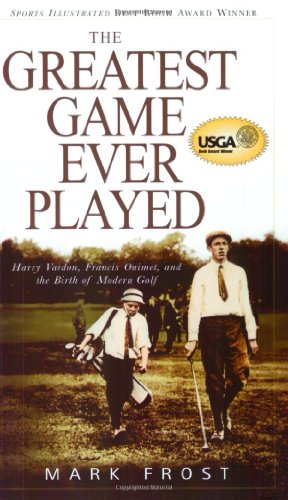
Mark Frost’s very thorough account of 20-year old former caddie Francis Ouimet knocking off the British titans Harry Vardon and Ted Ray at the 1913 U.S. Open is the perfect encapsulation of that weekend when golf went from being a very exclusive pastime to something that became an American obsession.
Why it made the list: Ouimet (amateur) crossed the street from his working class home to play in the National Championship at The Country Club in Brookline, MA, with his 10-year old caddie Eddie Lowery, facing two of the most feared champions in the world in a downpour of a playoff.
Frost runs two narratives side by side across the Atlantic: Vardon’s story of rising from the very bottom in Jersey and Ouimet’s story of struggling against class barriers in New England.
The last of the playoff chapters are pure cinema, really. You’re in the midst of it all even when you already know what’s going to happen.
Biggest Takeaway: How one fearless underdog performance democratized American golf and inspired a generation of working-class kids to pick up the game.
Who should skip it: Skip The Greatest Game Ever Played if you’re after a short read, as it’s a very long book (nearly 500 pages).
Frost spends a considerable amount of time in the pre-tournament background, going into the social and biographical detail of the period.
Tiger Woods by Jeff Benedict & Armen Keteyian
Best Modern Golf Biography

Based on over 250 interviews with those who knew Tiger Woods best, this #1 New York Times bestseller (and the basis for the acclaimed HBO documentary) is the most complete, unvarnished portrait of golf’s most iconic modern player.
Why it made the list: Investigative journalists Jeff Benedict and Armen Keteyian chart every chapter of Woods’s remarkable life: the grueling childhood training under Earl Woods, his unprecedented dominance in terms of both records and TV ratings, his public meltdown and the injuries that preceded his grueling late career comeback.
Not a highlight reel in any superficial sense. This is a proper examination of the psychological cost of being isolated your entire life and the burden of perfectionism.
It’s the kind of book that would go hand in hand with Hank Haney’s The Big Miss for the same sort of audience that wants to get a sense of both the genius and the very human side of the man in the red Sunday shirt.
Biggest Takeaway: An eye-opening look at the unmatched mental discipline—and personal cost—required to sustain Tiger Woods’s historic peak.
Who Should Skip It: If you’re looking for instructional swing advice or a light, feel-good piece, then definitely skip it. It’s an objective, thoroughly reported journalistic biography.
A Life Well Played by Arnold Palmer
Best Golf Memoir

Published shortly after his death in 2016, Arnold Palmer’s memoir is a collection of the personal stories, the values he lived by and the genuine humility that made him ‘The King’ in the eyes of so many people in golf.
Why it made the list: Rather than just a straight chronology of trophies, it’s structured around the principles that Palmer lived by on and off the course.
From his father Deacon’s strict lessons on sportsmanship in Latrobe, PA, through his fierce rivalries with Jack Nicklaus and Gary Player, to his passion for aviation.
Every chapter is Palmer at his warmest. It’s a constant reminder of just how much more important integrity, a firm handshake and genuine respect for the fans are than any scorecard.
Biggest Takeaway: Palmer’s timeless code of conduct—play boldly, treat every person on the course with equal respect, and always sign your autograph legibly.
Who should skip it: Skip A Life Well Played if you’re after technical swing instruction or hard-hitting investigative drama. This is an inspiring, reflective memoir.
The First Major by John Feinstein
Best Inside Look at the Ryder Cup

Bestselling sports writer John Feinstein gives us access to the team rooms, the captains’ meetings and the high pressure matches of the deeply emotional 2016 Ryder Cup, which was being played just days after the passing of Arnold Palmer.
Why it made the list: After a run of very poor results in the US and the formation of America’s much-mooted ‘Task Force’, captains Davis Love III and Darren Clarke were left with two very strong teams to send into Hazeltine National for one of the most vociferous, most exciting weekends in modern golf.
Feinstein’s unparalleled access to the locker room gives you the private doubts, the strategic pairings and the Sunday singles – the Patrick Reed v Rory McIlroy battle being the most iconic of them all.
Told in Feinstein’s usual style (wit and journalistic detail), it shows just how different the pressure of a Ryder Cup is from that of a normal stroke play tournament.
Biggest Takeaway: A fascinating look inside Ryder Cup team-room dynamics, captain’s picks, and how Davis Love III rebuilt American team chemistry under intense media scrutiny.
Who should skip it: Skip The First Major if you don’t follow pro tour golf or team formats since it’s all about PGA/European Tour players and match play.
Best Golf Humor & Storytelling Books
Unplayable Lies by Dan Jenkins
Best Golf Humor Book

Legendary Sports Illustrated writer Dan Jenkins delivers a cracking collection of hilarious essays, locker room stories and deadpan observations on everything from Tour stars to the most eccentric of weekend country club types.
Why it made the list: Few writers ever captured the sheer absurdity and the sheer misery of golf quite so perfectly as Dan Jenkins. It’s a career spanning the majors with Hogan, Palmer, Nicklaus and Woods.
Unplayable Lies is a mixture of genuine behind the scenes anecdotes and Jenkins’s very own Texan brand of humor.
It’s all there in spades, taking aim at golf’s most ridiculous traditions, the worst swing advice and the unshakeable belief of the weekend warrior.
It’s the perfect bedside/vacation read if you just want to laugh your head off at the sport rather than worry about your handicap.
Biggest Takeaway: A reminder not to take yourself—or a bad round of golf—too seriously, delivered by the funniest golf journalist in history.
Who should skip it: Skip Unplayable Lies if you’re after serious swing instruction or genuine motivational content. Jenkins’s humor is absolutely unapologetically irreverent and satirical.
The Bogey Man by George Plimpton
Best Classic Participatory Golf Journalism

Pioneering participatory journalist George Plimpton embeds himself as an amateur on the 1960s PGA Tour (playing with Palmer, Nicklaus and Snead) in one of the funniest, most entertaining sports books ever written.
Why it made the list: Having famously gone head to head with Archie Moore and taken snaps for the Detroit Lions, Plimpton turned his attention to professional golf. Playing in pro-ams at the Bing Crosby’s Clambake, the Bob Hope Desert Classic and the Lucky International.
Through the eyes of an 18-handicapper who’d never get off the first tee without suffering from the most crippling first-tee nerves you could imagine, Plimpton gives us the full gamut of the Tour in the mid 1950s: the colorful characters, the odd little superstitions and the quiet sense of camaraderie.
Over 50 years on, his sumptuous, incisive prose is still the best there is at capturing the universal psychological torture of the amateur standing over a three-foot putt in front of a crowd.
Biggest Takeaway: A timeless, hilarious portrait of the chasm between weekend amateur golf and PGA Tour greatness—and the shared obsession that binds both together.
Who should skip it: Skip The Bogey Man if you’re after modern golf instruction or modern Tour coverage. It’s a literary time capsule from the 1960s.
Frequently Asked Questions

What is the #1 best golf book of all time?
Ben Hogan’s Five Lessons: The Modern Fundamentals of Golf is universally regarded as the #1 golf book of all time.
Written in 1957 by nine time major champion Ben Hogan, it contains the definitive explanation of the grip, the stance, the posture and the swing plane. It remains the bible for the game to this day for both professionals and amateurs.
What is the best golf book for beginners?
Harvey Penick’s Little Red Book is hands down the best book for the beginner as it eschews all that technical jargon and just gives you simple, short lessons which you can put into practice straight away on the driving range.
If you’re looking for a book with a series of mechanical illustrations, then you should go for Ben Hogan’s Five Lessons alongside it.
What is the best golf book for the mental game?
Golf Is Not a Game of Perfect by sports psychologist Dr. Bob Rotella is the top book for improving your mental game.
It teaches amateurs how to build a reliable pre-shot routine, trust their swing under pressure, and let go of a bad shot without it derailing their round.
What golf books do PGA Tour pros read?
PGA Tour players are very much in the habit of reading Golf Is Not A Game of Perfect by Dr. Bob Rotella, Zen Golf by Dr. Joseph Parent and Every Shot Counts by Mark Broadie.
For the technical fundamentals and short game scoring, they’ll also often have Ben Hogan’s Five Lessons and Dave Pelz’s Short Game Bible on their shelves.
Can reading golf books actually lower your handicap?
Yes, reading targeted golf books can lower your handicap by improving your course management, your pre-shot routine and the efficiency of your practice.
Range time will build your muscle memory, but instructional/mental game books will eliminate the costly tactical errors (firing at a tucked pin, for example, or compound double bogeys) that cost the average amateur 5-10 strokes per round.
What is the best golf book for lowering scores around the green?
Dave Pelz’s Short Game Bible is by far the best book for getting strokes off the tee in the 100-yard range. It’s all based on decades of launch and spin data.
His ‘clock system’ teaches you exactly how to set your wedge to achieve a specific carry distance, control your spin on the green, and get out of the sand consistently.