How Long Should Golf Clubs Be?
How long golf clubs should be depends on your body measurements: the right length comes from matching your total standing height with your static wrist-to-floor measurement, while standard off-the-rack clubs are built for golfers roughly between 5’9″ and 6’0″.
If you fall outside that range, the wrong shaft length can disrupt posture, tilt your swing plane, and reduce impact consistency before you even start the backswing.
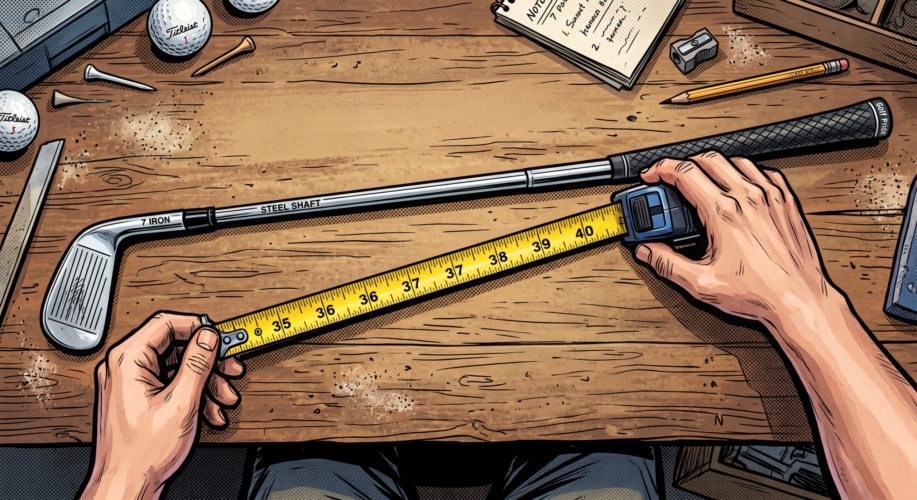
For golfers of any skill level who want better fit, comfort, and performance, this guide explains:
- how to measure for club length
- use height and wrist-to-floor sizing charts
- understand the swing factors that affect length
- compare different club types
- spot signs your clubs are too long or too short
- make the right adjustments to your set
Measuring Height and Wrist-to-Floor for Perfect Golf Club Length
Taking an accurate wrist-to-floor measurement is the single most critical step in establishing ideal club length because overall height alone does not account for individual arm length.
Two golfers standing the exact same height, such as 6’0″, frequently require completely different club lengths if one player has long arms and the other has short arms.
To measure your wrist-to-floor distance correctly:
- Wear standard flat athletic shoes or golf shoes to replicate your playing posture.
- Stand straight on a hard surface with your shoulders relaxed at your sides, letting your arms hang naturally into a comfortable stance without reaching for the floor.
- Have another person use a tape measure to check the exact distance from your primary wrist crease (where your hand meets your wrist) down to the floor.
Combining your overall height with your wrist-to-floor distance provides the precise baseline numbers custom fitting professionals need to determine whether you need standard length, extra shaft length added, or shorter clubs.
Golf Club Length Chart for Men and Women
A golf club length chart provides a direct starting point for finding the right club length based on your height and wrist-to-floor distance.
Standard length for men’s clubs in a 7-iron is typically built to 37 inches, while a standard women’s 7-iron averages around 36 inches.
Here are the baseline fitting recommendations used across standard industry charts:
| Player Height | Wrist-to-Floor Distance | Standard Length Adjustment | Recommended 7-Iron Length |
|---|---|---|---|
| 5’0″ – 5’3″ | 27″ – 29″ | -1.0 inch | 36.0″ |
| 5’3″ – 5’6″ | 29″ – 32″ | -0.5 inch | 36.5″ |
| 5’7″ – 6’0″ | 32″ – 35″ | Standard length | 37.0″ |
| 6’0″ – 6’3″ | 35″ – 38″ | +0.5 inch | 37.5″ |
| 6’3″ – 6’6″ | 38″ – 41″ | +1.0 inch | 38.0″ |
Taller players often need added length, while shorter players may need reductions in club length up to 1 inch.
When your static measurement falls right on the boundary between two shaft lengths, your dynamic swing characteristics, swing style, and skill level act as the final tiebreaker.
The Physics of Club Length: Swing Speed vs. Better Control
Length matters for both speed and control, but club length is not the only factor in distance or accuracy.
Longer clubs generate higher potential clubhead speed due to a wider swing arc, while shorter clubs make it easier to hit the ball with better control and more consistent ball striking.
When evaluating length against performance, consider these trade-offs:
- Distance Potential: A longer shaft increases the physical radius of your swing circle, generating higher velocity at the clubhead to help you hit the ball farther only when contact is centered.
- Impact Accuracy: Centered contact becomes significantly harder to execute as shaft length increases; missing the sweet spot by just half an inch sharply reduces energy transfer, makes solid contact less likely, and ruins ball flight.
Trading away a couple of miles per hour in potential swing speed in exchange for hitting the sweet spot consistently with a manageable shaft length will lower your scores faster than playing maximum-length equipment.
How Dynamic Factors Impact Your Club Length Requirements
Dynamic swing characteristics change how the club sits at impact, meaning static height measurements are only the first half of finding the right golf club length.
Your setup posture, transition tempo, and release point all dictate how a specific club length performs once the club is in motion, while helping you maintain a natural athletic posture during the swing.
Swing Style and Swing Plane
An upright posture with a steep swing plane functions best with slightly longer clubs or a steeper lie angle to prevent the toe from digging into the turf, though different swing patterns may also call for different lengths.
Golfers who naturally crouch lower with a flatter swing plane benefit from a shorter shaft length to keep the clubhead flat through the hitting zone, and playing style can also influence whether a golfer performs better with a slightly shorter or longer build.
Skill Level and Impact Consistency
Advanced players with repeatable swing mechanics can handle longer drivers or irons without sacrificing center-face contact.
Beginners and high-handicappers usually benefit from choking down or playing shorter clubs that maximize forgiveness and center-face impact.
Lie Angle Considerations
Modifying shaft length directly alters your effective lie angle.
Adding half an inch of length makes the club play roughly 1 degree upright, raising the toe and potentially causing shots to pull to the left if the lie angle isn’t adjusted accordingly by a club maker.
Any time you change club length, check lie angle, since length adjustments can alter shot direction and dispersion.
Sizing Driver, Iron, and Putter Lengths
Choosing the right club in each category is a key part of finding the ideal length across the bag, since standard length rules must be adapted based on whether you are hitting off a tee, sweeping off the turf, or rolling a putt.
| Club Category | Primary Focus | Common Custom Adjustment |
|---|---|---|
| Driver | Speed vs. Accuracy Tradeoff | Shorter shafts (44.5″ – 45″) |
| Irons | Progressive Length Gapping | 0.5-inch steps between clubs |
| Putters | Eye Position & Alignment | Range from 33″ to 35″ |
Driver Shaft Length
Retail drivers are often sold at 45.75 to 46 inches to promote maximum distance, yet many Tour professionals play shorter drivers between 44.5 and 45 inches.
Trimming a driver shaft gives you significantly tighter shot dispersion without sacrificing measurable distance.
Iron Length Progression
Iron length follows a strict set progression, shifting by half an inch for every change in club number.
If your customized 7-iron length is set to 37.5 inches, your 6-iron will measure 38.0 inches and your 8-iron will measure 37.0 inches.
Putter Sizing
Standard putters are sold at 34 or 35 inches, and most putters fall between 33 and 35 inches. But correct putter length depends on placing your eyes directly over the ball at address.
Longer putters can suit golfers who stand more upright at address. Playing a putter that is too long forces an upright posture, moving your eye line inside the target line and disrupting your path.
Signs You Are Playing With the Wrong Golf Club Length
Playing with improperly sized golf clubs forces compensatory movements into your swing mechanics that degrade accuracy, physical comfort, and your overall golf game.
Recognizing these operational warning signs helps identify when an equipment adjustment is overdue:
Symptom 1: Excessive Slicing or Hooking
Clubs that are too long force a flat swing path, leading to low pulls or hooks; clubs that are too short encourage a steep downswing that produces weak slices.
Symptom 2: Heel or Toe Impact Marks
This is one of the first clues many golfers notice, as consistently striking the ball off the toe indicates your shaft length is likely too short, while persistent heel strikes point to clubs that are too long.
Symptom 3: Poor Turf Interaction
Taking deep, heavy divots behind the ball happens when overly long clubs force a steep angle, whereas topping or thinning shots occurs when short clubs pull you out of your spine angle.
Symptom 4: Physical Back Strain
Bending over excessively to reach the ball causes lower back fatigue, signaling a need for longer clubs, while standing unnaturally upright means your current setup is too long.
Steps to Customize Your Golf Club Setup
Achieving a precise golf club fit requires a step-by-step evaluation that moves from static physical measurements to live-ball testing on a launch monitor.
1. Take Static Measurements (Baseline Phase)
Record your total height and wrist-to-floor distance using a flexible tape measure while standing straight in athletic shoes with your arms relaxed at your sides.
2. Cross-Reference the Sizing Chart (Initial Sizing)
Match your measurement numbers against a standard golf club length chart to create a starting point for choosing the right golf clubs, including baseline shaft length and lie angle adjustments.
3. Test Impact Patterns with Impact Tape (Live-Ball Testing)
Apply impact face tape or powder to your standard 7-iron and strike 10 balls off a mat or turf to analyze whether your strike cluster sits in the center, heel, or toe.
4. Schedule a Dynamic Club Fitting (Launch Monitor Analysis)
Work with a professional club fitter to test various shaft flex options, swing weights, and length combinations under real-time launch monitor conditions, and note that many golf shops and professional fitters can run these measurements and testing sessions.
5. Fine-Tune Your Set Progression (Full Bag Build)
Apply your verified sizing rules across your driver, fairway woods, hybrids, irons, wedges, and putter to maintain uniform feel and distance gapping throughout your entire bag while dialing in the perfect club length for each category.
How Long Should Golf Clubs Be?
Frequently Asked Questions
How do you size golf clubs for your height?
Sizing golf clubs for your height helps you find the perfect clubs and a better starting fit by combining your total standing height with a static wrist-to-floor measurement.
Start by standing upright in flat shoes with your arms hanging naturally at your sides, then measure from your main wrist crease straight down to the floor.
Cross-reference these two numbers on a standard golf club length chart to estimate the right golf club length based on your height before dynamic testing.
For instance, a golfer who is 6’1″ with a 36-inch wrist-to-floor distance will typically need clubs extended by half an inch over standard specs.
Once baseline specs are set, a professional club fitting evaluates dynamic swing characteristics, lie angle, and impact consistency on a launch monitor to fine-tune final length requirements.
Many golf shops can handle this measurement and fitting process if you do not want to do it at home.
What is the 70/30 rule in golf?
The 70/30 rule in golf is a foundational strategy concept stating that 70% of your shots on the golf course occur from within 100 yards of the green, while only 30% are full shots taken off the tee or fairway.
Because short-game shots, wedge play, and putting dominate your overall score, this principle emphasizes spending 70% of your practice time fine-tuning pitch shots, chipping, sand saves, and putter stroke consistency.
Applying the 70/30 rule to equipment means prioritizing custom fitting for your wedges, short irons, and putter length just as carefully as your driver, ensuring control, distance precision, and proper posture where most of your score is actually determined.
Does a 6-2 golfer need longer clubs?
A 6’2″ golfer is among the taller players and usually requires longer clubs, typically extended by +0.5 inches over standard specifications, but height is only a starting point.
If a 6’2″ player has proportionally longer arms, their wrist-to-floor measurement might match standard length requirements, allowing them to play standard clubs without issue. By contrast, longer or shorter arms relative to height can change the final fit.
Conversely, a tall golfer with shorter arms needs extended shafts to prevent excessive stooping, lower back strain, and poor posture at address.
Playing with clubs that are too short forces a steep downswing plane, leading to thin shots, inconsistent ball striking, and lost power.
Visiting a professional fitter ensures your height, arm proportions, and swing style are properly calculated so they can determine the right length and size clubs for you.
What length are Rory McIlroy’s irons?
Rory McIlroy plays custom irons built around a standard 37.25-inch 7-iron length, with shaft lengths stepping in standard half-inch increments throughout his set.
His 3-iron measures 39.25 inches, progressing down to a 36-inch pitching wedge, paired with True Temper Project X 7.0 steel shafts tailored to his explosive swing speed.
Despite his powerful move and elite distance off the tee, McIlroy maintains traditional iron length specifications rather than extended shafts.
This setup gives him optimal swing plane control, consistent turf interaction, and center-face impact, proving that proper club fitting is about precision, distance control, and repeatable mechanics rather than simply adding extra length for distance.