How to Reduce Spin on Your Driver
Learning how to reduce spin on driver isn’t rocket science.
It’s all about optimizing your attack angle, hitting the ball higher up on the club face, and making smart choices with the right gear, like a driver with lower spin or a stiffer shaft.
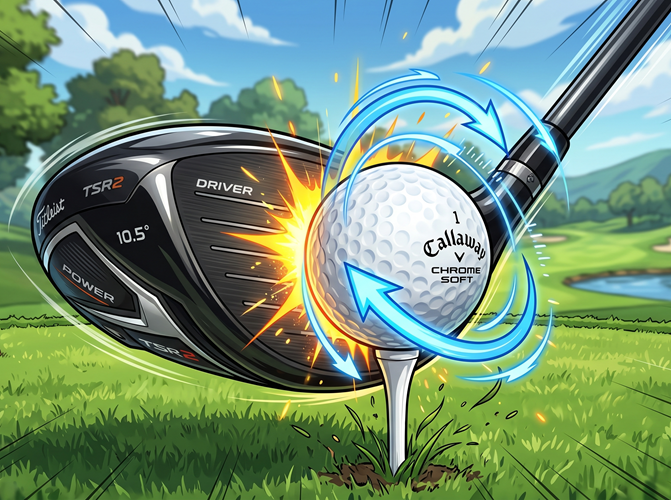
We all know that getting more distance is the holy grail for golfers.
And for good reason, hours spent on the driving range, fine-tuning your swing and pushing to increase your clubhead speed only to look up and see your ball soaring into the sky, stalling out and then falling straight back down with zero roll.
Yes, that’s the sound of excessive spin at work.
I’ve been hitting golf balls for a living for over 25 years now, and back in the day before we had the fancy launch monitors we have today, if you didn’t have a good intuition of the ball flight, you were in the dark.
But now, with all the technology we have available, it’s easier than ever to see exactly what’s going on with your game.
But here’s the thing. If your driver spin is too high, it basically acts like a parachute, sucking speed and carry out of your ball and reducing your total yardage.
Let’s break down exactly why this is happening and how you can tame the spin on your driver to unlock your full potential off the tee.
The Spin Dynamics of Your Driver
Get to Know the Physics Behind a Golf Shot
Before we look at possible fixes, you need to understand the physics behind a golf shot. When your driver hits the ball, a number of factors come into play to decide how much spin you get.
Your Spin Rate: Understanding the Numbers
Your spin rate is measured in revolutions per minute (RPM). And for a driver, your optimal spin rate is usually anything between 2,000 and 2,600, depending largely on club speed.
So if your launch data is showing a spin rate that’s pushing north of 3,500, you’ve got a high spin problem on your hands.
And it’s not doing you any favors, and ball speed also helps show whether strike quality and launch conditions are costing you distance.
Spin Rate (RPM) | What's Happening to Your Distance |
Under 2,000 RPM | Your spin is too low: it's falling out of the air |
2,000 - 2,600 RPM | Spin is just right: you're getting the best carry and roll |
Over 3,000 RPM | Your spin is too high: the ball is ballooning out of control |
Spin Loft and Dynamic Loft
Getting a Grip on the Numbers
So what exactly determines your spin?
It’s all about static loft and dynamic loft.
- Static loft is the actual angle on the sole of your driver.
- Dynamic loft is the actual angle of your clubface when you make contact with the ball.
If the attack angle stays equal, increasing the dynamic loft increases spin loft and therefore spin.
And the difference between these two is what we call spin loft. Think of spin loft like a wedge. The larger the angle between how the club is moving and where the face is pointing at impact, the more spin you get as a result.
To get a low spin profile, you want to make sure this window is as small as possible.
Spin Axis: The Directional Tilt That’s Killing Your Distance
Backspin is what keeps your ball in the air, but the spin axis is what determines the directional tilt. So if your spin axis tilts to the right or left, the backspin quickly converts into a slice or a hook.
When you learn to tame the spin, you also get to stabilize the spin axis and keep your drives flying straighter.
The Swing Mechanics of a Low-Spin Driver
Too many golfers assume they need to spend a small fortune on new gear to solve a spin problem. But the reality is that the answer usually lies in your physical golf swing and swing mechanics.
With a few tweaks to your movement patterns, you can make a huge difference in your spin numbers.
Increase Your Attack Angle: Hitting It High
Your attack angle (or Angle of Attack, AoA) is all about whether you’re hitting the ball down on it or up on it.
- Negative AoA: Hitting down on the ball as you do with irons. This creates high spin and a ballooning flight.
- Positive AoA: Hitting up on the ball. This positive AoA lets you launch the ball higher with less spin.
So how do you adjust your attack angle? It’s all about your setup.
Move the ball further forward in your stance and align it with the inside of your left foot if you’re right-handed. Then, add a slightly lateral shoulder tilt away from the target at address.
This encourages your driver to sweep upward through the hitting zone, creating an optimal launch angle without adding more backspin.
It can help you launch it higher without producing a higher trajectory that spins too much.
Impact Location: Focus on the Hitting Zone
Where the ball strikes the club face alters your spin rate. It’s all down to a bit of physics known as the gear effect.
- Low on the face and your balls spinning like crazy. The point of contact on the clubface changes spin, and backspin increases significantly.
- Center or just above center, and your spin drops, and the ball goes flying high.
If you keep making impact low on the face, that strike can add roughly 1000 rpm of spin.

PRO TIP
Get yourself a can of dry foot spray or some specialized strike tape on your clubface during practice, and you’ll get a good idea of exactly where your ball is hitting. This will help you adjust your swing until you’re consistently getting a center hit.
Making Some Technical Equipment Adjustments
If your swing is solid but you’re still ending up with ballooning shots, then it’s time to think about equipment changes. The way your club is set up can make a big difference to the spin you get.
Tweaking the Center of Gravity and Clubheads
Modern drivers have weight ports that you can move around to adjust how they play. If you want to minimize spin, place the extra weight closer to the face.
This pushes the center of gravity (CG) forward, reducing dynamic loft and helping the club hit the ball more cleanly, which in turn reduces spin.
If your current driver isn’t adjustable to your liking, then you might want to look at a lower spinning head. These heads have a CG position built in that will help out players with fast swing speeds.
Getting Your Loft and Tee Heights Just Right
It seems counterintuitive, but using a driver with less loft can actually help to reduce your spin rate. The lower static loft means less friction when the ball hits the club, reducing spin.
However, if you go down a loft, then you need to make sure you’re not sacrificing too much of your launch angle. You might want to try teeing the ball up a bit higher to make sure it still clears the trees.
You can also try messing around with different tee heights. Teeing the ball up high makes it a lot easier to sweep it upward and hit it just above the center of the face, which helps reduce spin.
Finding the Right Shaft Profile
Your shaft is effectively the engine of your club. If you’re using a shaft that’s not right for your swing speed, then you’re going to struggle to control the club.
Stiff Shafts vs. Flexible Shafts
If your shaft is too flexible, it’s going to bend forward excessively as it hits the ball, which increases dynamic loft and creates a lot of spin. Switching to a stiffer shaft will help to keep the face square and reduce the spin.
Shaft Characteristics: Stiffness and Spin
Shaft Attribute | Tip Section | Spin Profile |
High-Launch Profile | Flexible / Soft | Higher Spin |
Low-Spin Profile | Firm / Stiff | Lower Spin |
When you’re looking for a low spin shaft, then pay attention to the tip section. A stiffer tip will help prevent the club from bending forward as it hits the ball, which helps keep the spin under control.
When comparing different heads, using the same shaft makes it easier to isolate spin differences.
How Golf Ball Selection Impacts Spin
It’s surprising how many golfers spend loads of money on clubs but forget to think about the one thing they use on every single shot, the golf ball.
Low Spin Balls vs. High Spin Balls
Golf balls are designed with different core formulations and cover materials that suit different needs. Some balls will spin a lot more than others:
- Premium Tour Balls: These balls use urethane covers that are designed to spin as much as possible around the greens which is great for control but might not be so good if your strike is off.
- Distance-Oriented Balls: These balls use firmer ionomer or Surlyn covers which tend to spin a lot less off the tee.
If you’re struggling with high driver spin, then trying a ball that spins less might be a good way to get your flight pattern sorted without having to change your swing too much.
Putting It All Together
A Step-by-Step Plan
If you want to sort out your driver performance, then follow this simple plan during your next practice session:
- Check Your Strike: Get a good feel for exactly where the ball is hitting the club face by applying some foot spray or putting some strike tape on the face.
- Adjust Your Stance: Move the ball a bit forward and tilt your shoulders a bit to hit the ball up on the face.
- Get Your Tee Height Right: Make sure at least half the ball is sitting above the crown of the driver at address.
- Testing and Analyzing Your Game: Use a launch monitor to look at how changes you make to your swing affect your spin rate and how far the ball carries.
How to Reduce Spin on Driver
Frequently Asked Questions
Why is my driver spinning off the handle?
Most of the time, a driver with a lot of spin is down to hitting the ball low on the clubface, swinging down at it, or using a shaft that’s just too flexible for your swing. All these factors increase spin loft and increase friction at impact.
What’s the 70/30 rule for driving?
The 70/30 rule is just a rough guide, saying that 70% of your total driving distance is how far the ball carries through the air, and 30% is the bit that rolls out once it hits the fairway. Getting a low spin rate is pretty key to getting this balance just right.
Is less spin good for your driver?
Generally, yes it is. The less spin you can get away with, the better. As long as you’ve still got enough to keep it in the air. Most players are looking at around 2,000 to 2,600 RPM. Anything around this mark is usually pretty sweet for carry and roll.
Does lowering the loft on a driver really reduce spin?
Yep, lowering the loft definitely reduces spin. Less spin loft to play with at impact, that sort of thing. But don’t go too low. If you’re not careful, you’ll be launching the ball straight into the rough.